Border Monitoring Over the Korean DMZ
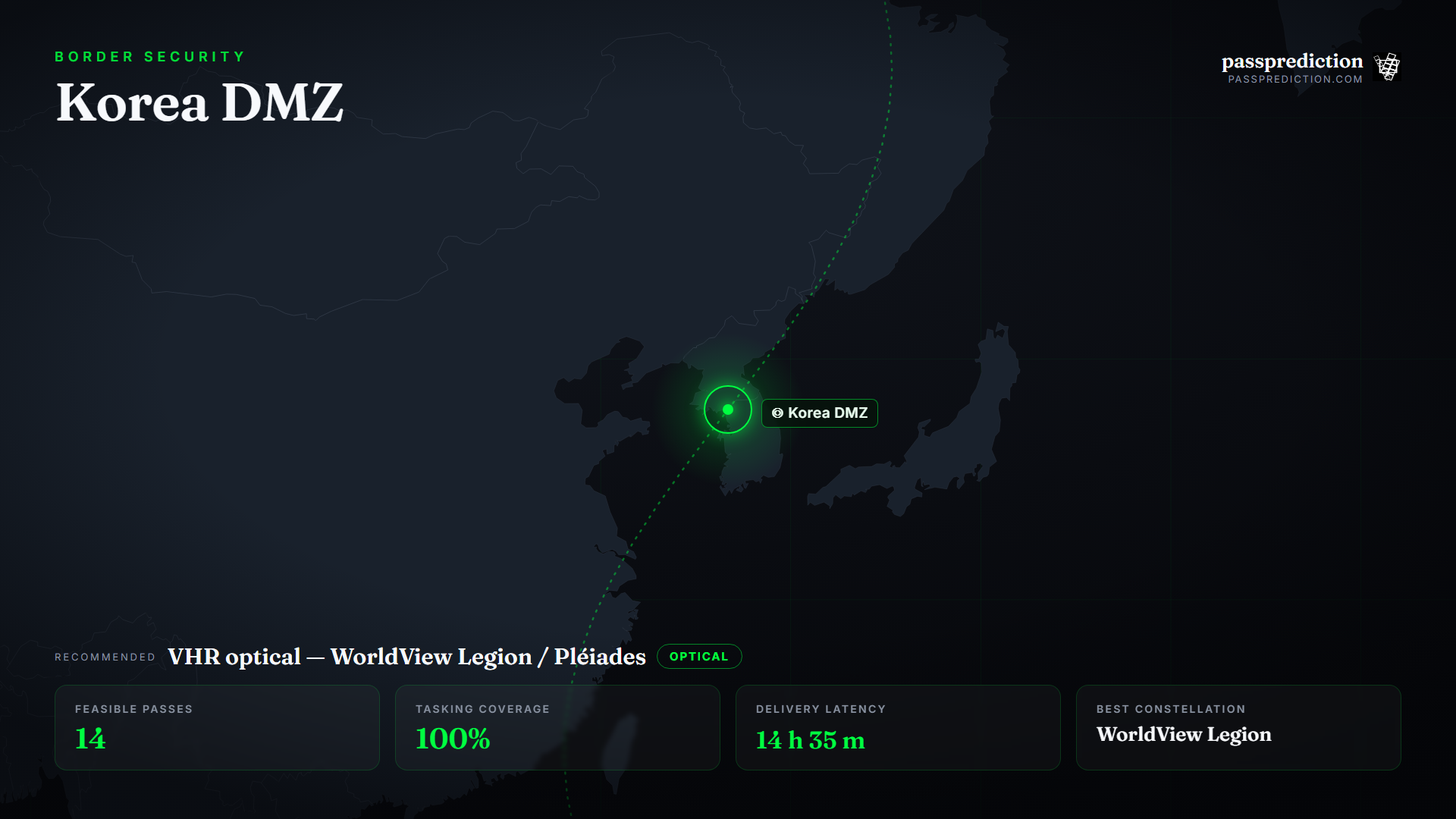
The Korean Demilitarized Zone runs roughly 250 km across the peninsula and is among the most heavily monitored borders on Earth. Analysts watch it for infrastructure change, new construction, tunneling indicators, and movement — activity that only shows up if you can both resolve individual vehicles and structures and revisit often enough to catch a change soon after it happens.
That combination of sub-50 cm detail and high revisit is the domain of very-high-resolution optical tasking. PassPrediction lets you draw the corridor as your AOI, find every VHR optical pass that crosses it in your window, and rank those passes so you spend tasking budget on the acquisitions that actually resolve the detail and cover the ground you care about — then order from whichever operator wins.
Define the corridor and the revisit cadence
A border is a long, thin AOI, so plan it as the corridor itself and evaluate every pass whose swath crosses it rather than a single point. Change detection lives or dies on cadence: a recurring plan across multiple VHR satellites tightens effective revisit so a new structure or vehicle concentration is caught days — not weeks — after it appears.
Set a low off-nadir tolerance for the passes you keep. Near-nadir geometry keeps building edges, vehicle counts, and small structures interpretable and makes successive scenes easier to co-register for change detection, which is the entire point of monitoring a border rather than photographing it once.
Why VHR optical wins here
Resolving vehicles, revetments, and construction demands sub-50 cm ground sampling, and today that means a VHR optical constellation. WorldView Legion delivers 30 cm-class imagery with the collection capacity to revisit a fixed corridor frequently, and Pléiades adds further high-resolution passes to tighten the cadence — between them you get both the detail and the frequency change detection needs.
Optical is the right primary sensor because interpretation here is fundamentally visual — what is this structure, how many vehicles, is this new — and VHR panchromatic plus multispectral supports that directly. Where cloud or darkness would break the series, PassPrediction lets you add a SAR pass to keep coverage unbroken, but the anchor is high-resolution optical.
Turn feasibility into a plan
Run a pass search over the corridor for your window, filter to daylight and low off-nadir, and sort by coverage so the passes that sweep the most of the DMZ rise to the top. The tasking step shows how each swath lands across the corridor and how many passes it takes to cover its full length.
Layer in the latency estimate to see when each scene could be delivered, and run the constellation comparison to rank WorldView Legion, Pléiades, and any other feasible option on resolution, revisit, and geometry. You leave with a neutral, ranked plan and place the order with the operator that best fits.
Recommended constellation
VHR optical — WorldView Legion / Pléiades — over the Korea DMZ Area of Interest.
- Optical VHR (≤0.5 m) — Sub-50 cm detail to resolve vehicles, structures, and new construction along the corridor.
- High-revisit optical (Legion-class) — Frequent passes over a fixed corridor so change is caught days, not weeks, after it appears.
- SAR (X / C-band) — All-weather, night-capable fill so a cloud or darkness gap does not break the change series.
The mission, run over Korea DMZ
Feasible passes
14 feasible passes over the AOI in 3-day.
| Best pass | Start (UTC) | Coverage | Off-nadir |
|---|---|---|---|
| WorldView Legion 6 | 2026-07-14T03:43:07.254933+00:00 | 33.5% | 2.1099315750140835° |
Delivery latency
| Stage | Duration |
|---|---|
| Order ingest | 10 s |
| Uplink wait | 4 m |
| Execution | 11 h 56 m |
| Downlink wait | 2 h 23 m |
| Processing | 10 m |
| Delivery | 1 m |
| Total | 14 h 35 m |
Downlinked through Tolhuin Partner Station. Downlinking through the KSAT and AWS Ground Station antennas nearest the corridor — in the Asia-Pacific region — minimises the time from a Legion or Pléiades pass to imagery in the analyst's hands.
Constellation comparison
| # | Constellation | Score |
|---|---|---|
| 1 | WorldView Legion | 1.00 |
| 2 | WorldView | 0.57 |
Frequently asked questions
What resolution do I need to monitor a border?
Sub-50 cm to resolve individual vehicles and small structures. That is VHR optical territory — WorldView Legion-class 30 cm imagery with high revisit.
How do I keep a long border fully covered?
Plan the AOI as the corridor and sort passes by how much of it each swath covers, then stack multiple satellites to shorten the revisit needed for full-length coverage.
Why near-nadir look angles for change detection?
Low off-nadir keeps building and vehicle edges interpretable and makes successive scenes easier to co-register, which is essential when you are differencing images to detect change.
Does PassPrediction task the satellites for me?
No. PassPrediction does not sell imagery — it plans feasibility across all operators, then you order from the provider of your choice.
Plan a feasible acquisition
Draw your Area of Interest, set the window and look-angle limits, and PassPrediction ranks every feasible pass across all operators — neutrally, in your browser, free to start.
Open the planner →