Flood Mapping Across the Ganges–Brahmaputra Delta
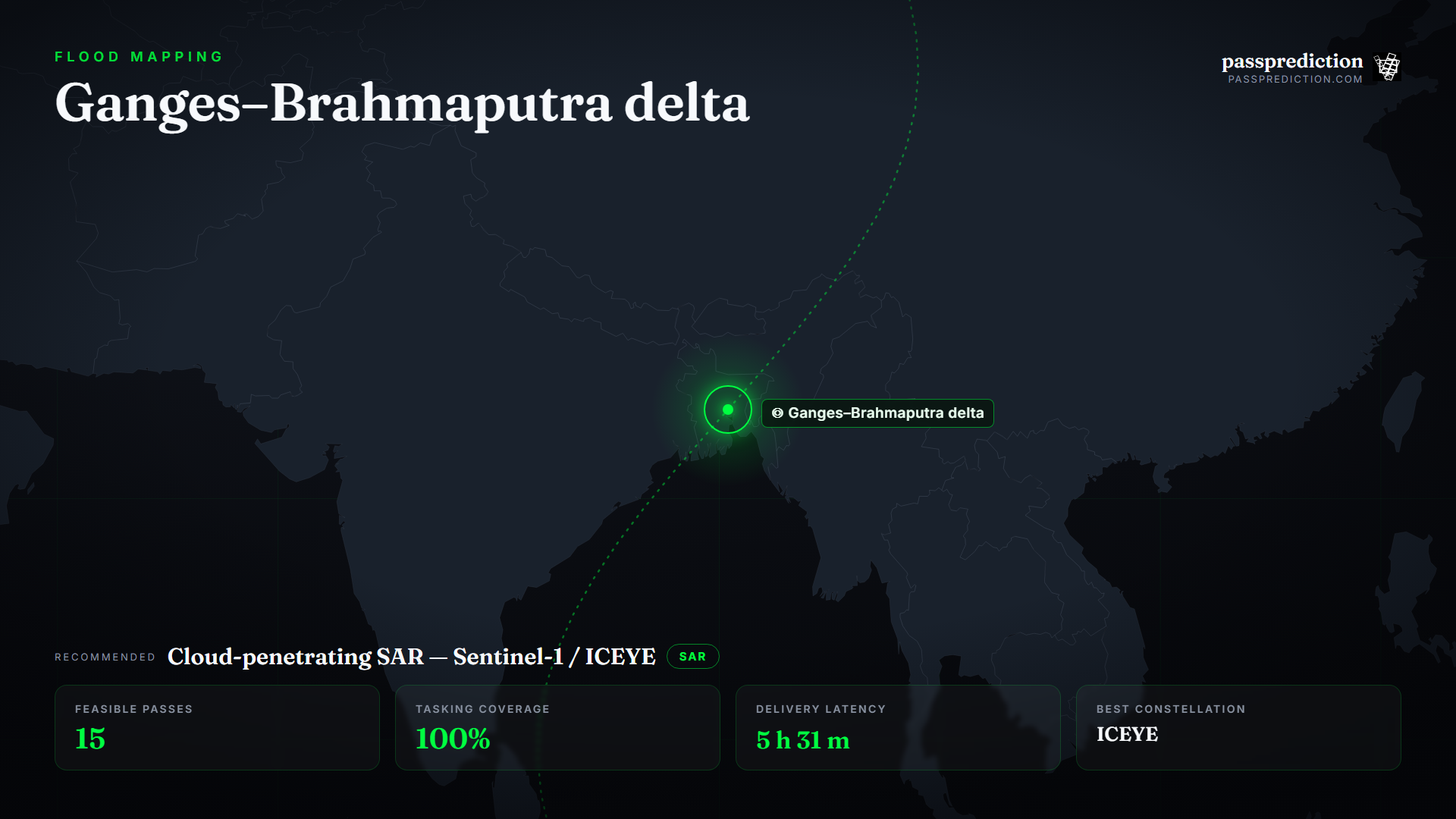
The Ganges–Brahmaputra delta in Bangladesh is the most flood-exposed delta on Earth, where monsoon inundation displaces millions each year — and is almost always hidden under thick cloud. Relief agencies and disaster authorities need flood-extent maps during the event, when the water is rising, not weeks later when optical skies finally clear.
Only cloud-penetrating SAR maps flood extent reliably through the monsoon, so Sentinel-1 and ICEYE are the right tools. PassPrediction lets you draw the delta as your AOI, find every SAR pass that sweeps it in your window, rank them by coverage and delivery time, and compare options — so you plan a flood-mapping cadence that keeps working when optical is useless.
Define the delta AOI and the flood window
Draw the AOI as the affected delta region — flooding is distributed across a vast low-lying plain, so you want every pass whose wide swath touches any part of it. Set the window around the inundation event and, for a rising flood, plan repeat passes so you can track extent as it grows rather than capturing a single snapshot.
Because the flood is the signal and it is under cloud, sensor availability is the binding constraint, not daylight or look angle. PassPrediction surfaces the SAR passes that can actually see through the weather so you plan against acquisitions that will deliver, not optical passes that will return cloud.
Why cloud-penetrating SAR wins here
Water flattens the surface and returns little radar energy, so open water appears dark and sharply bounded in SAR imagery — making radar the definitive sensor for mapping flood extent. Crucially, SAR penetrates the thick monsoon cloud that grounds optical for the entire event, and works day or night, so the map is available while the flood is happening.
Sentinel-1 provides a free, wide-swath C-band baseline with regular revisit, and ICEYE adds commercial X-band passes to tighten cadence and fill gaps between them. Combining a free wide baseline with taskable commercial fill is exactly the kind of cross-operator plan PassPrediction is built to compare and sequence.
Turn feasibility into a plan
Run a pass search over the delta for the flood window and sort by coverage so the wide passes that blanket the plain rise above those clipping its edge. Plan repeat SAR passes to follow the flood as it evolves, and use the tasking view to confirm the swaths cover the affected districts.
Add the latency estimate so extent maps reach responders while they still drive evacuation and relief, and run the constellation comparison to sequence the free Sentinel-1 baseline with taskable ICEYE fill. The result is a ranked, neutral flood-mapping plan you fulfil with the SAR sources of your choice.
Recommended constellation
Cloud-penetrating SAR — Sentinel-1 / ICEYE — over the Ganges–Brahmaputra delta, Bangladesh Area of Interest.
- Wide-swath SAR (Sentinel-1 C-band) — Free, regular, cloud-penetrating baseline that maps flood extent across the whole delta.
- Taskable SAR (ICEYE X-band) — Commercial passes to tighten cadence and fill gaps as the flood evolves.
- Repeat-pass SAR series — Track extent growth and recession over the event rather than a single snapshot.
The mission, run over Ganges–Brahmaputra delta, Bangladesh
Feasible passes
15 feasible passes over the AOI in 3-day.
| Best pass | Start (UTC) | Coverage | Off-nadir |
|---|---|---|---|
| ICEYE-X42 | 2026-07-15T04:47:26.658979+00:00 | 100% | 0° |
Delivery latency
| Stage | Duration |
|---|---|
| Order ingest | 10 s |
| Uplink wait | 35 m |
| Execution | 3 h 53 m |
| Downlink wait | 51 m |
| Processing | 10 m |
| Delivery | 1 m |
| Total | 5 h 31 m |
Downlinked through Tolhuin Partner Station. KSAT and AWS Ground Station antennas in the Asia-Pacific region give the sun-synchronous SAR fleets frequent low-latency contacts, so flood maps reach responders during the event.
Constellation comparison
| # | Constellation | Score |
|---|---|---|
| 1 | ICEYE | 1.00 |
| 2 | Capella | 0.00 |
Frequently asked questions
Why SAR and not optical for flood mapping?
Monsoon floods sit under thick cloud that grounds optical for the whole event. SAR penetrates cloud and works day or night, so flood extent is mapped while the water is rising.
How does SAR show flooded areas?
Open water flattens the surface and reflects little radar energy back, so it appears dark and sharply bounded in SAR imagery — a clean flood-extent signal.
Can I combine free and commercial SAR?
Yes — a free Sentinel-1 baseline gives regular wide coverage, and taskable ICEYE passes tighten the cadence. PassPrediction sequences both across operators.
Does PassPrediction sell the imagery?
No. PassPrediction does not sell imagery — it plans feasibility across all operators, then you order from the provider of your choice.
Plan a feasible acquisition
Draw your Area of Interest, set the window and look-angle limits, and PassPrediction ranks every feasible pass across all operators — neutrally, in your browser, free to start.
Open the planner →