Tailings & Stockpile Monitoring at the Escondida Copper Mine
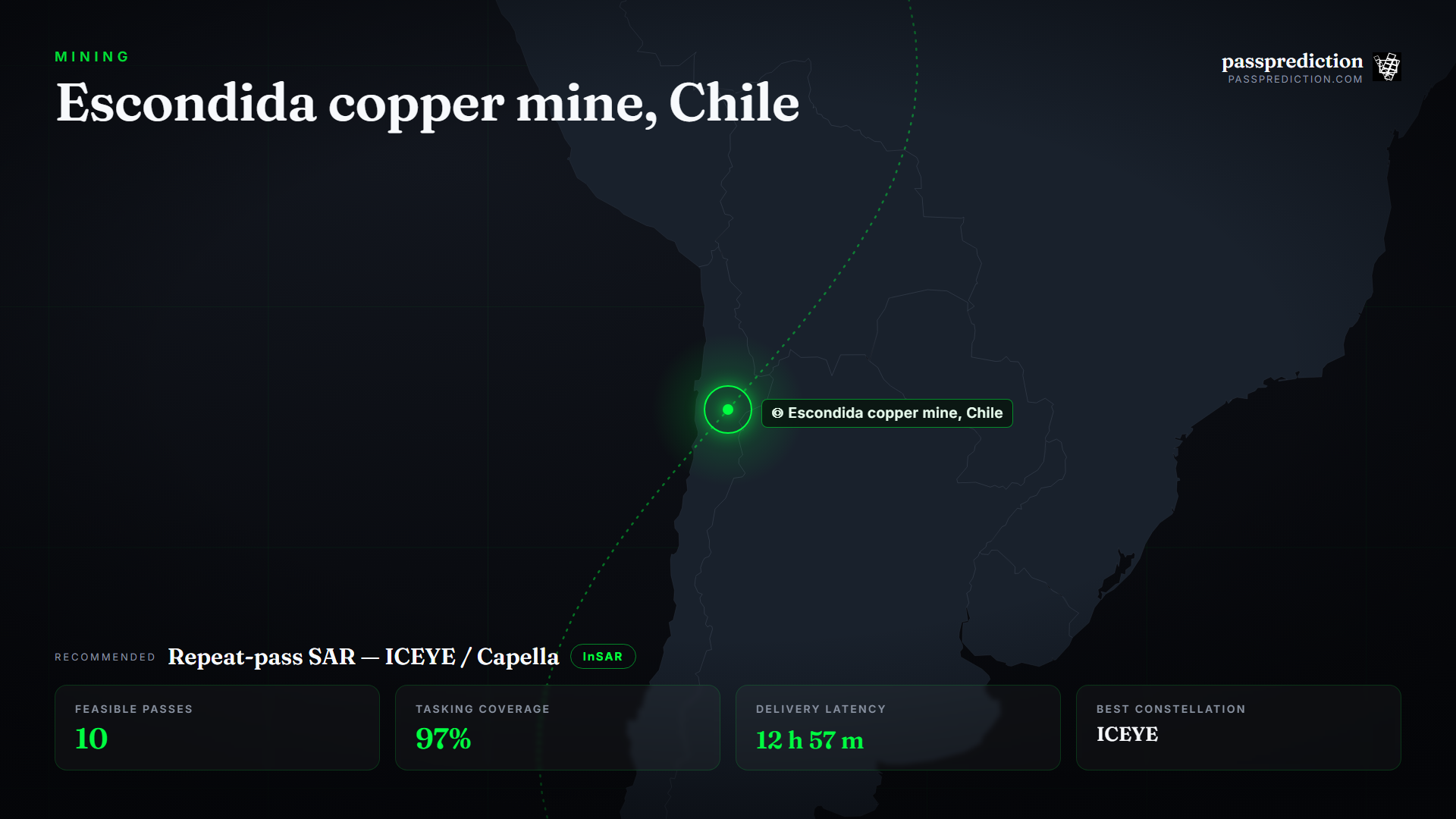
Escondida in Chile's Atacama Desert is the world's largest copper mine, and its operators, financiers, regulators, and insurers watch it for two things above all: ore-stockpile volumes, and — critically — tailings-dam stability, where millimetric ground deformation can precede a catastrophic failure. Over so remote a site, satellite monitoring is often the only independent, defensible data source.
Measuring that deformation reliably is a repeat-pass SAR interferometry (InSAR) job, and ICEYE / Capella provide the consistent radar geometry it needs. PassPrediction lets you draw the mine and tailings facility as your AOI, plan the fixed-cadence SAR acquisitions InSAR requires, and compare constellations — so you build a monitoring programme, not just a single image.
Define the AOI and the monitoring cadence
Set the AOI to the lease — pit, stockpiles, and the tailings storage facility — because a monitoring programme documents the whole site over time, not one feature once. InSAR is intrinsically a repeat-measurement technique, so plan a fixed cadence: consistent passes over the same ground let you resolve the slow deformation signal that is the early warning of instability.
For stockpile volumetrics, a periodic optical-stereo acquisition complements the SAR series. Either way the planning unit is a cadence, and PassPrediction shows the upcoming passes over the AOI so you can lock a consistent schedule rather than chasing opportunistic scenes.
Why repeat-pass SAR (InSAR) wins here
Ground deformation is measured by comparing the phase of radar returns between passes, which only works when successive acquisitions share a stable look angle and orbit geometry. ICEYE and Capella provide that consistent repeat-pass SAR, detecting millimetre-scale movement across a tailings dam or pit wall — the signal that has become a standard safety-monitoring tool after high-profile dam failures.
Radar also ignores the desert's day-night cycle and any cloud, so the deformation series stays unbroken. Optical stereo still earns a place for stockpile and pit volumes — differencing successive surface models quantifies extraction — but the safety-critical measurement is InSAR, and it demands the disciplined, consistent geometry PassPrediction helps you plan.
Turn feasibility into a plan
Run a pass search over the site and select SAR passes that share a consistent geometry, so the interferometric stack is coherent. Sort by coverage to confirm each pass captures the full tailings facility, and use the tasking view to see how the swath lands on the AOI.
Add the latency estimate so deformation products reach the safety team promptly, and run the constellation comparison to rank the SAR options on revisit and geometry consistency. The result is a ranked, neutral monitoring plan you fulfil with the SAR provider of your choice — with optical stereo scheduled alongside for volumetrics.
Recommended constellation
Repeat-pass SAR (InSAR) — ICEYE / Capella — over the Escondida copper mine, Chile Area of Interest.
- SAR for InSAR (repeat-pass) — Millimetre-scale ground-deformation monitoring for tailings-dam and slope stability.
- Optical stereo / tri-stereo VHR — Digital surface models for stockpile and pit volumetrics and change over time.
- Optical VHR (≤0.5 m) — Footprint, water management, encroachment, and rehabilitation documentation for ESG reporting.
The mission, run over Escondida copper mine, Chile
Feasible passes
10 feasible passes over the AOI in 3-day.
| Best pass | Start (UTC) | Coverage | Off-nadir |
|---|---|---|---|
| ICEYE-X21 | 2026-07-14T16:02:45.141208+00:00 | 17.4% | 5.824718702707518° |
Delivery latency
| Stage | Duration |
|---|---|
| Order ingest | 10 s |
| Uplink wait | 1 m |
| Execution | 11 h 36 m |
| Downlink wait | 1 h 9 m |
| Processing | 10 m |
| Delivery | 1 m |
| Total | 12 h 57 m |
Downlinked through KSAT TrollSat (Antarctica). KSAT's polar antennas capture the frequent high-latitude downlinks of the SAR fleet, and a regional South American station adds low-latency contacts for a remote Atacama site.
Constellation comparison
| # | Constellation | Score |
|---|---|---|
| 1 | ICEYE | 1.00 |
| 2 | COSMO-SkyMed | 0.43 |
| 3 | Capella | 0.04 |
Frequently asked questions
What is InSAR used for at a mine?
Detecting millimetre-scale ground movement between repeat SAR passes — the early-warning signal for tailings-dam failure and slope instability.
Why does InSAR need consistent geometry?
Interferometry compares the phase of radar returns between passes, which only works when the acquisitions share a stable look angle and orbit geometry.
How are stockpile volumes measured from space?
From elevation: stereo or tri-stereo optical builds a digital surface model, and differencing successive models over time quantifies volume change.
Does PassPrediction sell the imagery?
No. PassPrediction does not sell imagery — it plans feasibility across all operators, then you order from the provider of your choice.
Plan a feasible acquisition
Draw your Area of Interest, set the window and look-angle limits, and PassPrediction ranks every feasible pass across all operators — neutrally, in your browser, free to start.
Open the planner →